Thank you for writing to us. One of our executive will reach back to you through your submitted medium. In case there’s an urgency, feel free to connect over WhatsApp for faster response.
Prefer calling? Dial +918048128313 (International callers) or 08048128313 (Indian callers).
KNK15-16
•Kirkland 15-16
•Used for initial bevel incision for gingivectomy or gingivoplasty procedures.
•Easy to access to the distal surface of the posterior.
KNO1-2
•Orban 1/2
•The blade & shank are properly angled for posterior use.
•Useful for making tunnels of the recipient site.
•Used for removing and shaping bone
CHCO1
•Ochsenbein & Fedi Curved
•Used for reshaping a bone.
•Can also be used to reflect flaps or remove secondary palatal flaps.
•Useful to get a small amount of autogenous bone during implant surgery.
•To remove soft and hard tissue strongly stick to the palate.
•To remove thin bone after supporting the backside of the knife against the root surface.
CHCO2
•Ochsenbein & Fedi Curved
•Has a knife of opposite direction against CHCO1
CHC36-37
•Ochsenbein & Fedi Curved
•Back-Action
•Pull-stroke, ideal for removing bone adjacent to tooth without injury
•Useful for molar’s distal
CHS13K-13KL
•Kirkland
•Curved
•For removing and reshaping bone
CHC13K-TG
•Curved
•Suitable for root forming
CHCP3-4
•Straight
CHBC1
•Used for splitting bone.
•To separate coronal tissue while tunneling surgery. (periodontal plastic treatment or tunneling techniques for bone graft)
TITU1
•Anterior
•Tunneling for the flat area
•To take tissue or insert tissue into tunneling
TITU2
•Tunneling for the heavy curved area
TITU3
•Combination of TITU1 & TITU2
TITU4
•10˚angle
•Similar to TITU1 but Knife is rounded.
TITU5
•30˚angle
•To keep expanding toward the curved area.
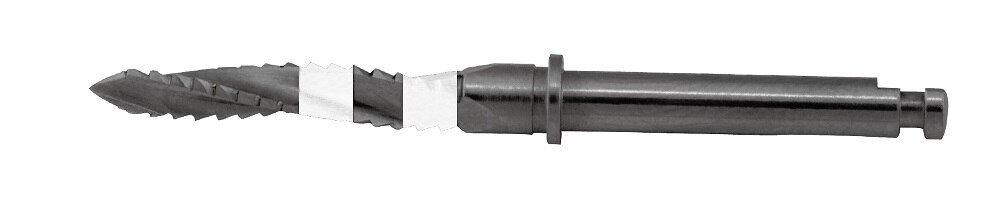
•Specially-designed blades make excellent cutting power in verticality and horizontality.
•Useful for multiple implants procedures. Specially used for relocation and redirection.
•Effective for thick cortical bone cutting.
•Effective for the site preparation of socket for an immediate implant.
LLS21 2.1mm Diameter
LLS26 2.6mm Diameter
LLL21 2.1mm Diameter
As it is long enough, it is very useful when a drill cannot access to the aiming position easily, due to the proximal teeth.
LLL26 2.6mm Diameter
As it is long enough, it is very useful when a drill cannot access to the aiming position easily, due to the proximal teeth.
Implant Depth Gauge
DG1
•Used for checking the depth of the socket.
•Can also be used for checking if the sinus membrane is perforated.
•Gradation scale by 24mm with 3mm interval.
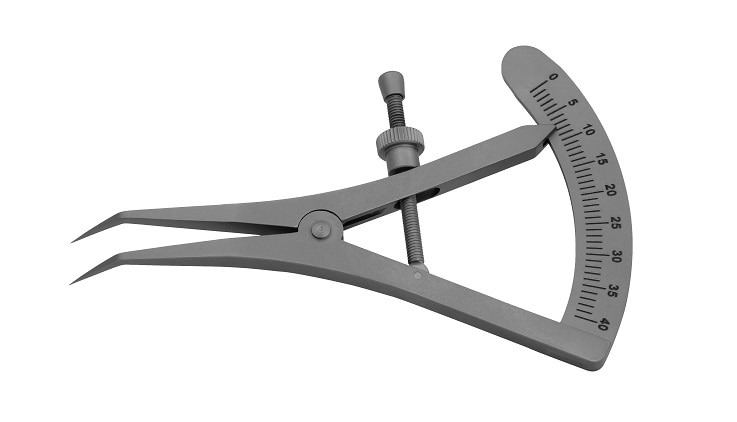
Caliper
LPC90
Caliper, Castroviejo
•Castroviejo 30 Angled
•Length 90mm the scope of measurement is 0~40mm
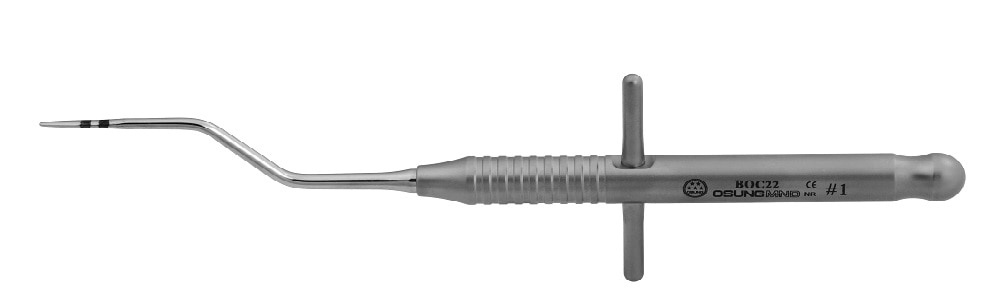
1. Easy to operate with supporting bar on the handle
2. Offset design for easy access in posterior
3. Gradation mark to measure the depth
4. Use a mallet if necessary
BOC22 2.2mm
BOC28 2.8mm
BOC35 3.5mm
BOC35R 3.5mm
•Used for expanding bone width in case of narrow alveolar bone.
•Used for getting stable osseous tissue by compressing bone toward lateral when it is difficult to get Initial fixation due to low alveolar bone density.
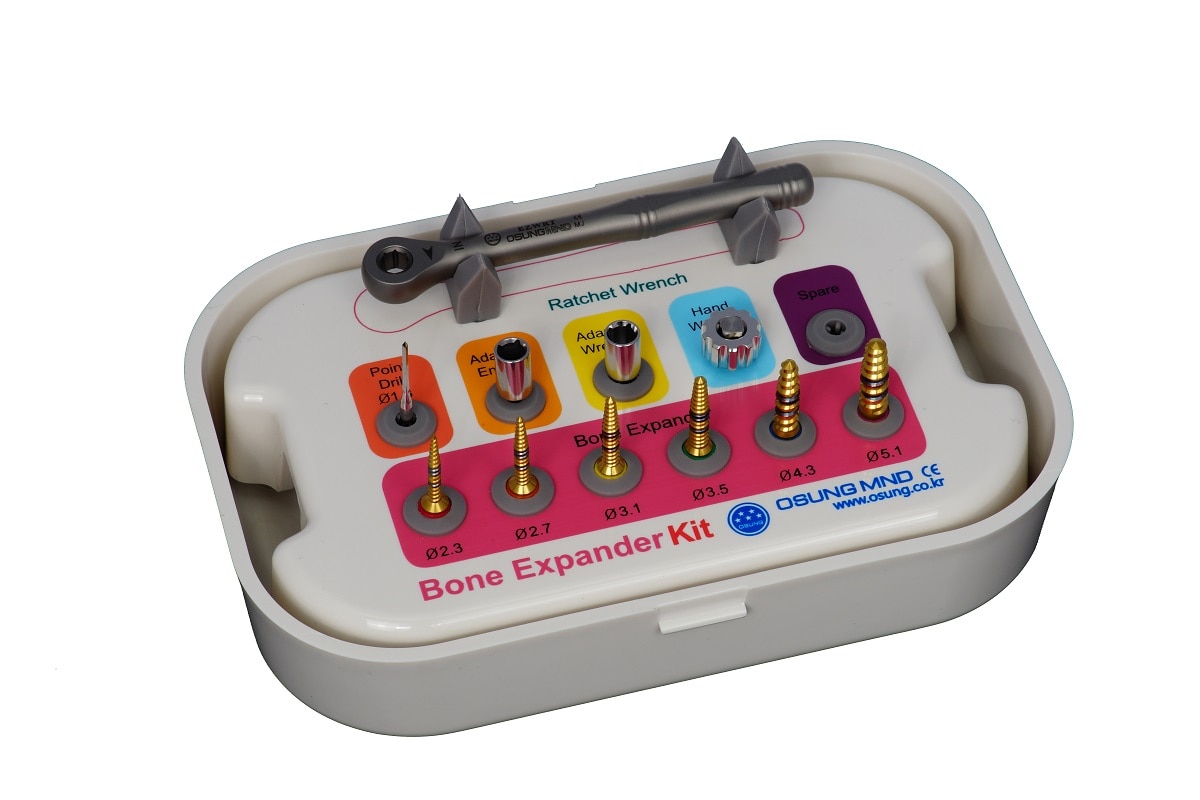
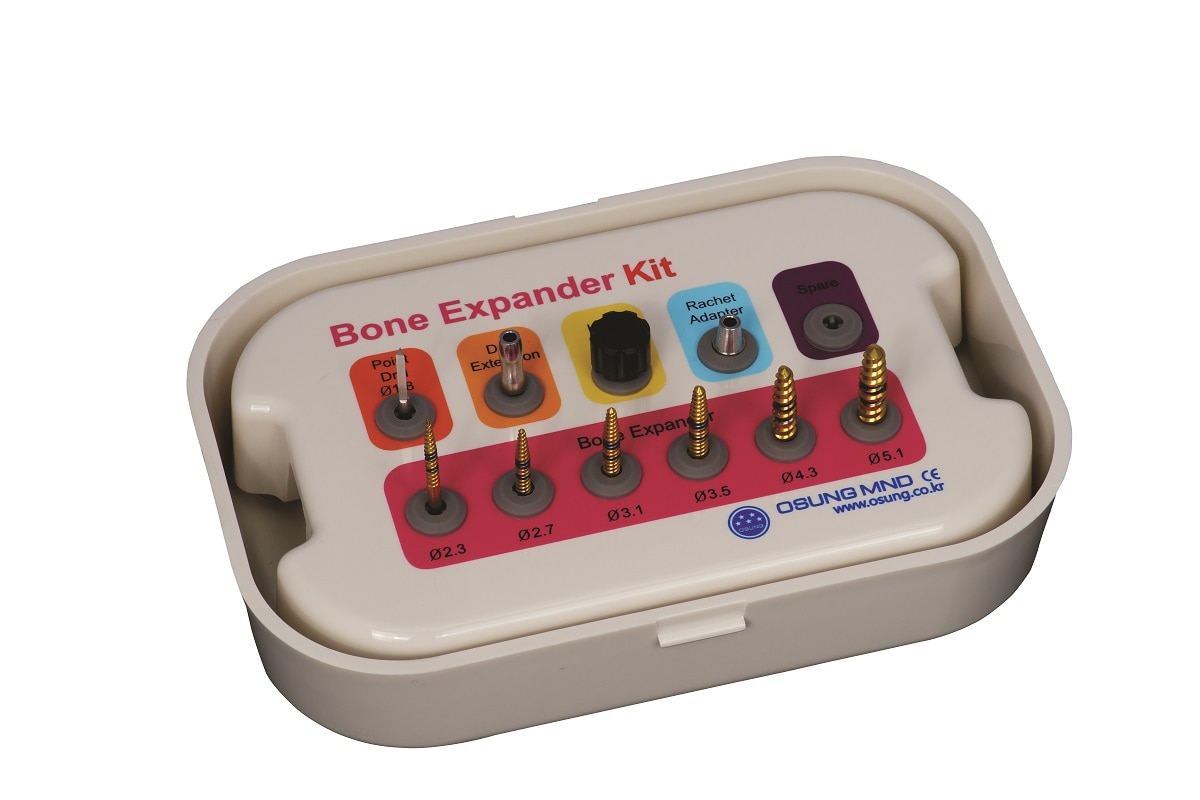
Ratchet Wrench: Used for tightening or loosening the expander.
Engine Adapter: For using the expander with an engine.
Point Drill ø1.3: Used for making a position where a fixture is to be placed.
Length Extension: Used for extending the length of the expander.
Hand Driver: Used for tightening or loosening the expander by finger instead of a ratchet wrench.
Expander:
Apical Diameter
1) 1.0mm 2.3mm
2) 1.4mm 2.7mm
3) 1.8mm 3.1mm
4) 2.2mm 3.5mm
5) 3.0mm 4.3mm
6) 3.8mm 3.8mm
•How to choose the final size of an expander?
1) Normal bone density : choose the same size as the fixture size.
2) Poor bone density : choose two step smaller size than the size of the fixture.
Length Extension: Used for extending the length of the expander.
Drill ø1.8 : Used for making a position where a fixture is to be placed.
Hand Driver : Used for tightening or loosening the expander by finger instead of a handpiece.
Ratchet Adapter: Connect an expander with a ratchet wrench
Expander:
Apical Diameter
1) 1.0mm 2.3mm
2) 1.4mm 2.7mm
3) 1.8mm 3.1mm
4) 2.2mm 3.5mm
5) 3.0mm 4.3mm
6) 3.8mm 3.8mm